
Reynolds' Bookshelf
138 Crabtree Road
Hot Springs, Arkansas 71913
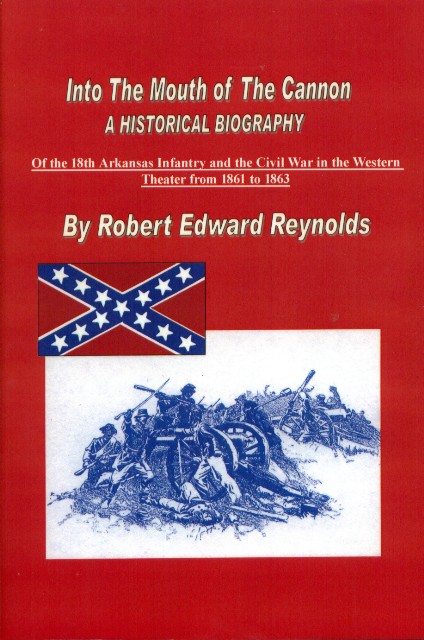
Into The Mouth of The Cannon
By Robert E. Reynolds
Into The Mouth Of The Cannon
The Battle of Fort Pillow Tennessee, The Siege of Corinth Mississippi, The Battle for Iuka Mississippi, The Siege Port Hudson, Louisiana, The Fall of Vicksburg , The Seizure of Little Rock in September 1863 and the Camden Campaign are included in the book, as well as many events. The book offers a in-depth look at the18th Arkansas tracks and the realities and suspense of the Civil War.
The book is a true story that is well-documented. Each chapter has numerous source reference note numbers authenticating the research. The book is indexed and also contains an appendix making it easy to do research and is illustrated. It also contains letters written during the Civil War period never published before. The book reads with the ease of a novel. It is filled with factual accounts that pull the reader into the events taking place on the written pages. The rebel yells, the ear-splitting roar of the cannon and the heart wrenching cries of the wounded hold your interest as you are pulled into the story. Truly this is a book full of action, suspense. The writer carries you right into the realities of the Civil War.
D. L. O.
During the siege of Corinth, the 18th was called on to reinforce a Missouri brigade, only to find that the Missourians had retreated from hard fought ground they were trying to hold. Shouting "Butler" in one accord, the regiment entered the field and again faced the mouth of the cannon, for Battery Powell was bristling with artillery and had been reinforced at that very moment by an entire division. After the assault on Battery Powell, the regiment would rightly be called by the name "The Bloody 18th Arkansas Infantry."
Excerpt from Chapter 7: Captain Thrasher, an officer in Company D. 18th Arkansas, described the rain of terror that belched from the cannons. “In front of the works was an open space of about 250 yards, somewhat obstructed with logs and brush. Over this space we were ordered by General Cabell to charge at double-quick. A murderous storm of iron and leaden hail came down furiously upon us from the batteries, and as we advanced, volley after volley of musket balls, like the thickening blasts of a hurricane, swept the field.”
Confederate Military History Vol. 10, Chapter 12
Excerpt from Chapter 9: (Port Hudson: A Confederate Fortress on the Mississippi) The Siege of Port Hudson began on May 23, 1863. A vastly outnumbered force of determined southern defenders was pitted against 30,000 union soldiers. What began on that day was a siege that was to last for 48 days. This was the longest siege in United States military history. Ferocious assaults were thrown against the 6,800 brave defenders during the siege. These actions constituted some of the most severe and bloodiest fighting of the entire Civil War. The siege took a heavy toll on both union, and confederate forces. Estimated casualties on the union side were over 5,000 men. The confederate forces suffered greatly also. Towards the end of the siege, the confederate army had exhausted their ammunition. They had to resort to eating mules, horses, and rats to keep from starving.
Excerpt from Chapter 9: Colonel William M. Parish commanding officer of the18th Arkansas wrote to his wife, March 1863, describing Admiral Farragut's fleet bombarding Port Hudson: "We have gained a signal victory over the Yankees. We were attacked last night by the Federal fleet. It resulted in a heavy loss to the Yanks. Our batteries succeeded in burning one of their best seagoing frigates mounted with 22 guns and the sinking of another. Two boats succeeded in passing our batteries though it cannot do the Feds much good. As it will keep them busy to keep our Red River gunboats off of them. The scene during the engagement was the most beautiful that I have ever beheld. Though there was some terror it was interesting. The first we knew of the attack was the Yankee thunder busting from their mortar boats. We were aroused from our pleasant slumber where we were reposing in line of battle near our breastworks. Soon after the roaring the mortar boats their whole fleet was brought in to requisition (9 or 10 in number). They were soon in range of our batteries when they busted forth their destruction to the Yankees and Yankee boats, some throwing hot shot, some solid shot, and some shell. I cannot express the awful noise, it seemed as though the whole world was exploding and the air was filled with shot and shell (red hot shot) shells exploding in the pieces whistling in every direction, but strange to say there was but one or two of our men killed and about six or seven wounded, God is on our side."
William M. Parish
Excerpt from Chapter14: (The Hardships of Southern Women) The closing of the lower Mississippi River by Farragut's fleet had immediate positive results for the Union cause. The seizure of the port had far-reaching consequences for the South and in time would strangle her efforts to continue the struggle.
Because of the blockade the women of the Confederacy had to improvise with whatever resources were available. In the early part of the war this inspired Southern women to band together and pool resources. Communities of women--literally this was the case, for all able-bodied men were in the service--would come together to pool their resources in order to keep the war effort alive. Small cottage industries sprang up that were operated by women who were determined to furnish whatever was necessary for their men who had gone to battle. Women worked at looms, tanneries, and spinning wheels to ensure a continuous flow of supplies to the army. They gathered herbs, such as horehound, mullein, and boneset to furnish much-needed medications for the sick and wounded. The women cultivated poppy plants for medicinal purposes. When the plants reached a certain stage of maturity, they cut the stock. They then collected sap from the plant and dried it. This process was used to manufacture opium that was shipped to hospitals and doctors in the field. Opium was one of the principal painkillers used to relieve the anguish and suffering of the wounded during the Civil War
Clinks on link below to purchase book
https://www.authorhouse.com/en/bookstore/bookdetails/254655-Into-The-Mouth-of-The-Cannon
Contact Robert Reynolds rereyno@earthlink.net for additional information.
©2007 Robert Edward Reynolds. All rights reserved.
No part of this book may he reproduced, stored in a retrieval system, or
transmitted by any means without the written permission of the author.
First published by AuthorHouse 6/13/2007
ISBN: 978-1-4259-0605-4 (SC)
ISBN: 978-1-4343-0280-9 (HC)
Library of Congress Control Number: 2005910732
Printed in the United States of America
Bloomington, Indiana